Every few weeks I come across another article, panel, or LinkedIn thread trying to answer the same question: what can humans do that AI never will? The list changes a bit depending on who’s writing, but one item keeps showing up near the top: intuition.
It sounds like the perfect candidate. Intuition feels mysterious, personal, almost magical. That gut feeling that something’s off, that a deal is worth taking, that a design is going to work. Surely a machine can’t have that.
I’m not so sure. And more importantly, I think we’re asking the wrong question.
What intuition really is
Intuition is one of those things we all use and almost nobody stops to analyze. It’s wrapped in a lot of mysticism. That’s why I find Daniel Kahneman’s work so useful. Kahneman won the Nobel Prize for his research on how people actually make judgments and decisions.
In Thinking, Fast and Slow, he borrows a definition from Herbert Simon, another Nobel laureate and one of the pioneers of AI:
“The situation has provided a cue; this cue has given the expert access to information stored in memory, and the information provides the answer. Intuition is nothing more and nothing less than recognition.”
In other words, intuition is fast information processing based on experience. A doctor who spots a problem in seconds, or an engineer who just knows a design won’t scale, is recognizing patterns they’ve seen many times before.
Kahneman also looked at when intuition can be trusted. In a 2009 paper with psychologist Gary Klein, they concluded that expert intuition is reliable only when there’s “an environment that is sufficiently regular to be predictable” and “an opportunity to learn these regularities through prolonged practice.” Without those conditions, our gut is basically guessing, just with a lot of confidence. As Kahneman put it in a 2010 interview:
“Overconfidence is a powerful source of illusions, primarily determined by the quality and coherence of the story that you can construct, not by its validity.”
Why AI will win this race
If intuition is information processing built on experience, the conclusion is hard to avoid: in the medium to long term, AI will be better at it than we are. Storing and processing information is exactly what computers do best, and AI does it at a scale no human can match. We’re already seeing it in areas with lots of data and clear feedback, like chess, medical imaging, or fraud detection.
Two caveats, though:
- Kahneman’s conditions apply to AI too. AI’s “intuition” shines where there are regular patterns and plenty of data. In truly new situations it struggles just like a human expert does, and it can be wrong with complete confidence.
- Not all human experience is data. We learn from very few examples, and much of what we know is tacit, physical, or social. It was never written down anywhere. There, AI’s advantage is smaller, at least for now.
So here’s a fair way to put it: in anything that can be captured as data, AI’s intuition will eventually beat ours.
The wrong question
Which brings me to my main point. The whole debate about “what makes us better than AI” starts from the wrong place.
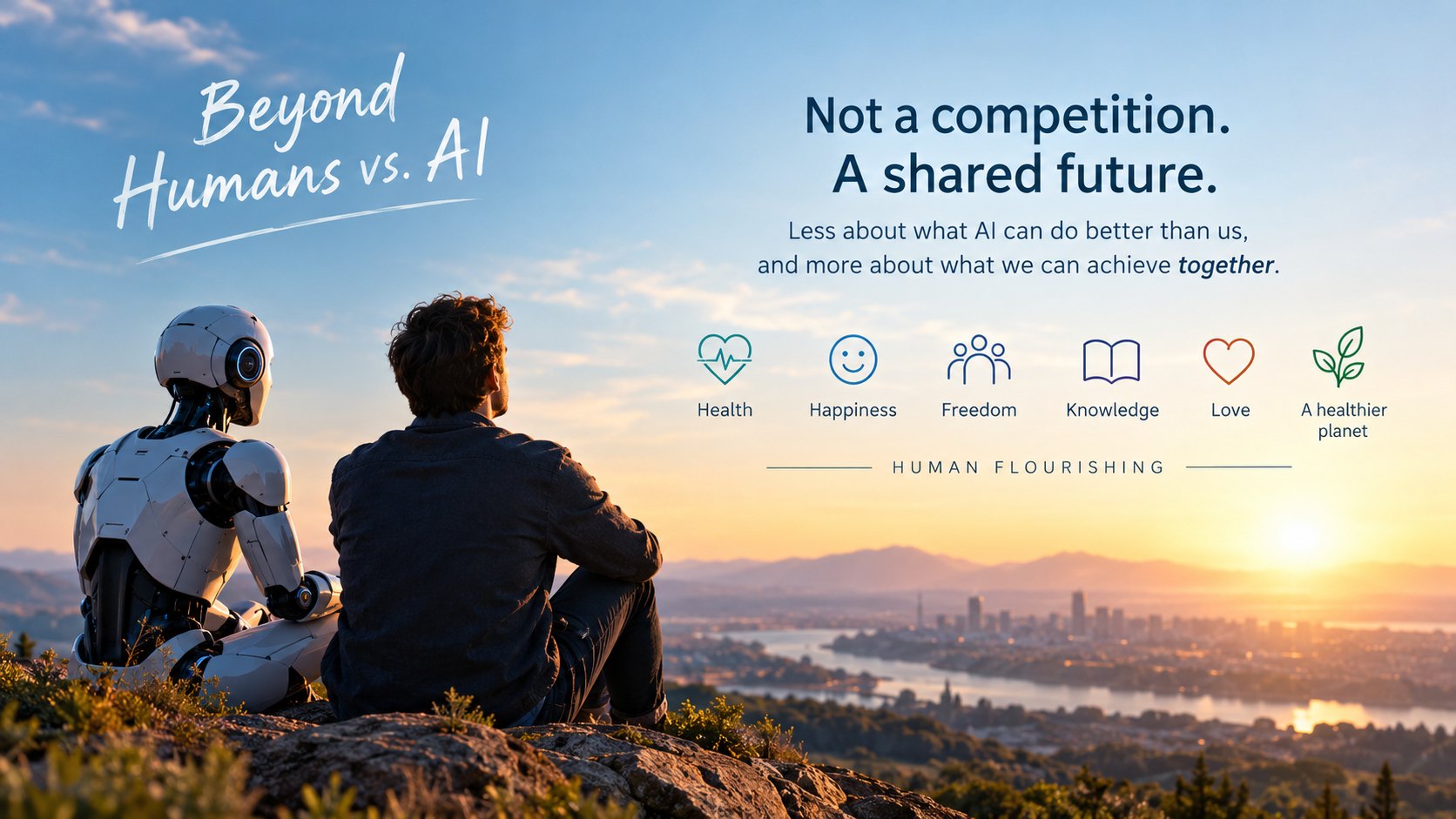
If what we want is for AI to benefit humanity and everything humanity cares about, then defining our value by how we stack up against AI makes no sense. It turns AI into a rival, and turns us into competitors in a race we’re bound to lose.
I’d rather take a more humanist approach, along the lines of Steven Pinker’s Enlightenment Now. As Pinker puts it:
“The goal of maximizing human flourishing—life, health, happiness, freedom, knowledge, love, richness of experience—may be called humanism.”
And his humanism isn’t limited to people: it includes the flourishing of animals too.
Seen this way, the question isn’t whether AI can do something better than we can. It’s whether it helps us live longer, healthier, freer, and happier lives, and whether it helps the planet we share. If an AI makes better intuitive calls than a doctor, that’s not a threat to the doctor’s dignity. It’s more lives saved.
So, where do we want to go?
It’s time to stop comparing skills between humans and AI and start figuring out what we actually want to achieve. AI will keep getting better at many of the things we do; that’s almost a given. The real challenge is deciding what’s worth doing with it.
Pinker is optimistic here: he argues there’s no limit to how much we can improve if we keep applying knowledge to human flourishing.
Which leaves me with a question I find much harder than any human-vs-AI comparison: are we really up to the task of dreaming about where we want to go, as a society and as humanity?
I’d love to hear what you think.